3.4. Broken Lead Detection
Overview
Broken lead detection is a feature of the Model 346 that monitors sensor input channels for disconnected or broken sensor leads. The instrument continuously evaluates whether a sensor lead has become disconnected or broken by checking for current source compliance during measurement cycles, and then alternates the check across both pairs of measurement leads.
How It Works
During each measurement cycle, the instrument drives a known excitation current through the sensor and monitors the resulting voltage to generate a sensor reading. If the voltage required to generate the current exceeds the compliance limit, it indicates that there may be an issue with the sensor lead. However, it is possible that this compliance can also be caused by an incorrect resistance range. To prevent false positives, the instrument requires three of five compliance detections to fail before a broken lead is flagged. After a set of five measurements is completed, the instrument swaps which leads are sourcing current and which are measuring voltage, and performs another detection cycle. This swapping process happens continuously during operation, allowing the instrument to monitor all four leads for broken lead conditions. Detections are performed only when positive current is being sourced through the sensor, so detection times can vary depending on EMF compensation settings and enabled scanner channels on the 3401 option card.
Two-Lead Failover
When two-lead failover is enabled, the instrument will automatically fall back to a two-lead measurement if a broken lead is detected. This routes both the current source and voltage sense through the same leads, omitting the broken pair and allowing the instrument to continue providing readings. While these readings are better than a floating reading caused by a disconnected lead, the readings are still less accurate than a four-lead measurement, as the lead resistance is only estimated based on an internal model of the lead resistance. In rare instances, if the sensor is undergoing a rapid temperature change at the time of lead break, the two-lead resistance estimation may be off or fail entirely. In which case the readings will be marked questionable and two-lead measurements will not be attempted.
Interface Command: TLFAIL
For more information on two-lead failover, see Two-lead Failover.
Resetting a Broken Lead Condition
If two-lead failover is enabled and a broken lead condition is detected, it must be explicitly reset. This can be done via the front panel or remote command. Resetting clears the latched status and allows the instrument to resume normal four-lead measurement.
Note
If the broken lead condition has not been resolved and the reset is attempted, the system will be unable to re-estimate the lead resistance accurately and will most likely fail. This is due to not having a correct four-lead reading to base the new two-lead resistance off of.
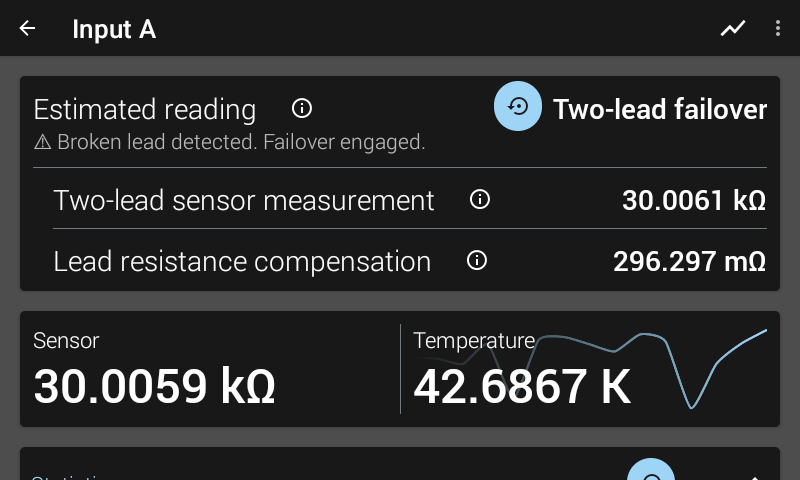
Figure 3.14 Two-lead failover reset screen, with a blue action button to reset the detection
Sensor Disconnection
If a sensor detects broken lead on both pairs of leads, reguardless of the failover setting, the sensor will be considered disconnected and the measurement will be invalid. All readings will be set to 0 with a questionable status bit (bit 8) set. This condition will immediately clear once one set of leads is reconnected.
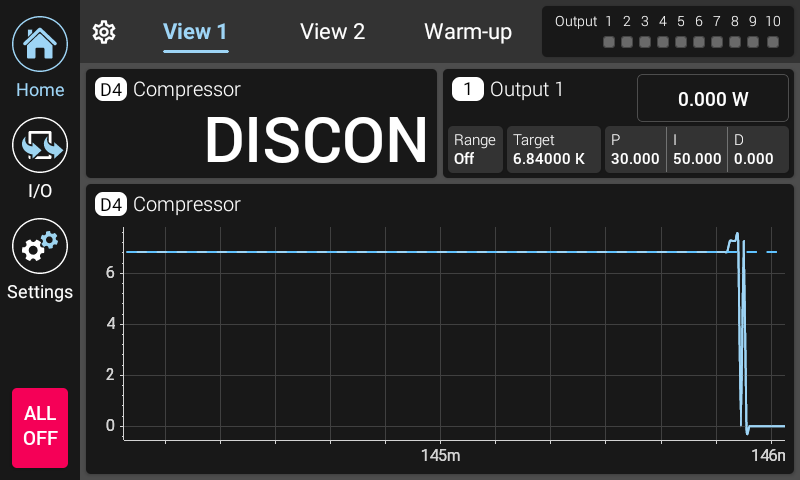
Figure 3.15 A reading of DISCON, indicating both pairs of leads are broken
Status Reporting
When a broken lead condition is detected, the corresponding questionable status bit (bit 1) is set in the input reading status. This bit remains set until the condition is explicitly reset in two-lead failover, or will clear when the condition is no longer present if failover is not enabled. If two-lead failover is enabled, a broken lead event on a sense lead is treated as a non-critical questionable condition, allowing the measurement to continue in two-lead mode.
Interface Command: SRDG?