1.1. Product Description
Features:
Operates down to 300 mK with appropriate NTC RTD sensors
Supports 10 sensor inputs as standard with easy expandability up to 26
Includes four high-power outputs for heaters up to 100 W
Four additional low-power outputs for up to 1 W of heater power or as analog outputs for temperature references
Ethernet IPv4 and IPv6, USB, and optional IEEE-488 GPIB interfaces
Two relays and two digital inputs for external device triggering
NRTL and CE certified
The touchscreen interface ensures simple setup and monitoring, while the included ColdSync™ software facilitates advanced setup, initial configuration, and comprehensive data monitoring.
Sensor Inputs
The Lake Shore Model 346 temperature controller includes 10 standard sensor inputs compatible with diode and RTD temperature sensors. With additional option cards, the controller can accommodate up to 26 total sensors, providing flexibility for complex or multi-zone measurement setups.
Supported sensors include:
Negative temperature coefficient (NTC) resistive temperature devices (RTDs) up to 100 kΩ such as Lake Shore Cernox® and Rox™ sensors
Positive temperature coefficient (PTC) RTDs up to 1 kΩ such as Lake Shore PT-100 Series sensors
Diodes with a maximum forward voltage of 2.5 V such as Lake Shore DT-670 sensors
Thermocouples with operating levels between ±50 mV (requires option card)
For resistance sensors, current reversal minimizes thermal electromotive force (EMF) errors. Seven selectable excitation currents support temperature measurement and control down to 300 mK using appropriate sensors. Autorange mode automatically scales excitation current to reduce self-heating at low temperatures, where sensor resistance can vary by several orders of magnitude.
The Lake Shore Model 346 temperature controller includes standard temperature sensor response curves for silicon diodes, platinum RTDs, and ruthenium oxide RTDs. Non-volatile memory can also store up to 40 200-point CalCurves for Lake Shore calibrated temperature sensors or user curves.
Temperature Control
Up to 8 independent control loops can be configured on the Lake Shore Model 346 temperature controller, with the first 4 being high-power 100 W outputs for 25 Ω heaters. The high-resolution PID-based control loops allow precise control of temperature with many control features and modes to suit most cryogenic systems. The physical heaters can also be grouped for situations where more than 100 W is desired in a single location. A special warm-up mode has also been included to simplify the process of warming a system up for sample exchange, reducing overall turn-around time.
Temperature limit settings for inputs are provided as a safeguard against system damage. Each input is assigned a temperature limit, and if any input exceeds that limit, all control channels are automatically disabled.
Interface
The Model 346 comes standard with Ethernet and USB interfaces, with an optional IEEE-488 (GPIB) parallel interface. Nearly all instrument functions can be controlled remotely, in addition to data acquisition. The USB interface emulates an RS-232 serial port at a fixed baud rate of 921,600, while still using standard USB connectors.
The 0 V to 10 V analog voltage outputs on outputs 5 to 8 can be configured to send a voltage proportional to temperature to a data acquisition system. You may select the scale and data sent to the output.
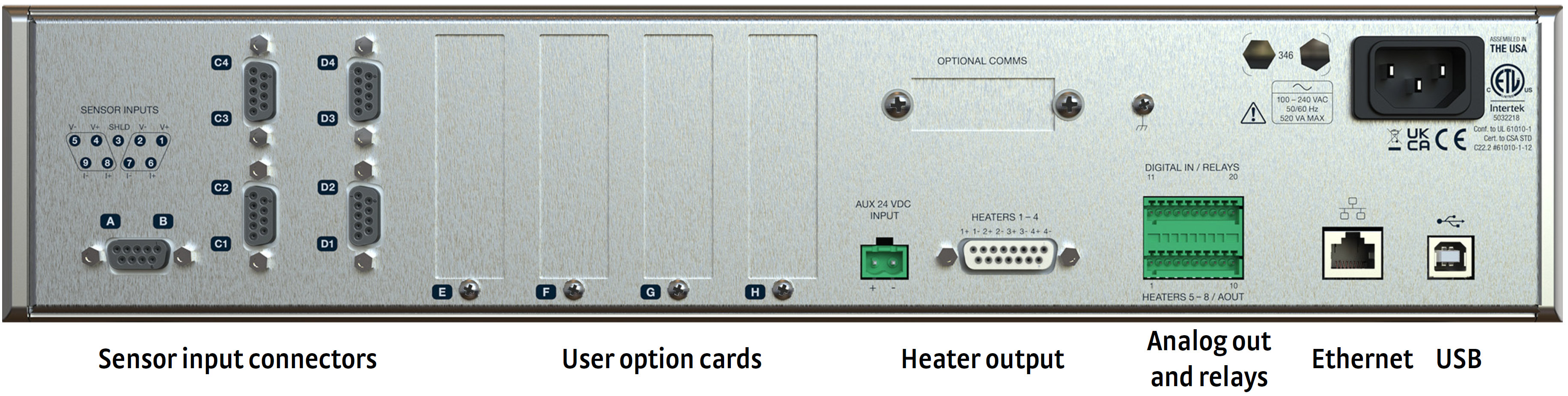
Figure 1.1 Model 346 rear panel
Option Card Slots
Up to four option cards can be installed in the Model 346. These option cards further expand the application versatility of the Model 346 by allowing specialized sensors to be switched in and out to achieve specific measurement objectives. Option cards and be mixed and matched in any combination.
For example, addition of the 2-channel thermocouple input option card (Model 3402) enables continuous measurement to 1000 K and above. The 4-channel scanner option card (Model 3401) enables use of additional sensors for supplemental monitoring.
Additional option cards may be released in the future. To support the potential need for additional power to run future option cards, a 24 VDC auxilliary input has been included on the back of the instrument. This input is not needed for any of the currently available option cards, so this input is currently unused.